Automate Customer Onboarding with AI Workflows: Complete SaaS Implementation Guide
Most SaaS companies rely on static email sequences and manual check-ins for customer onboarding, leading to 15-20% higher churn rates and thousands of wasted CSM hours annually. AI workflows can dynamically personalize the entire onboarding experience based on real user behavior, boosting feature adoption by 30% while reducing support tickets by 40%.
This guide shows you exactly how to build intelligent onboarding workflows that adapt in real-time to user actions, not just demographics.
The Problem: Manual SaaS Onboarding is Bleeding Revenue
Customer Success Managers at mid-market and enterprise B2B SaaS companies face the same crushing reality. Generic onboarding sequences treat a CEO exploring dashboards the same as a project manager diving into task management features.
Manual outreach consumes 15-25 hours per CSM weekly on repetitive tasks. Generic email sequences ignore actual user behavior, sending irrelevant content that drives disengagement. Critical features remain undiscovered because timing and context are wrong.
This costs enterprise SaaS companies roughly $50,000-$100,000 annually per CSM in lost productivity. More importantly, poor onboarding contributes to 10-15% higher early-stage churn rates.
Exact AI Workflow for Customer Onboarding Automation
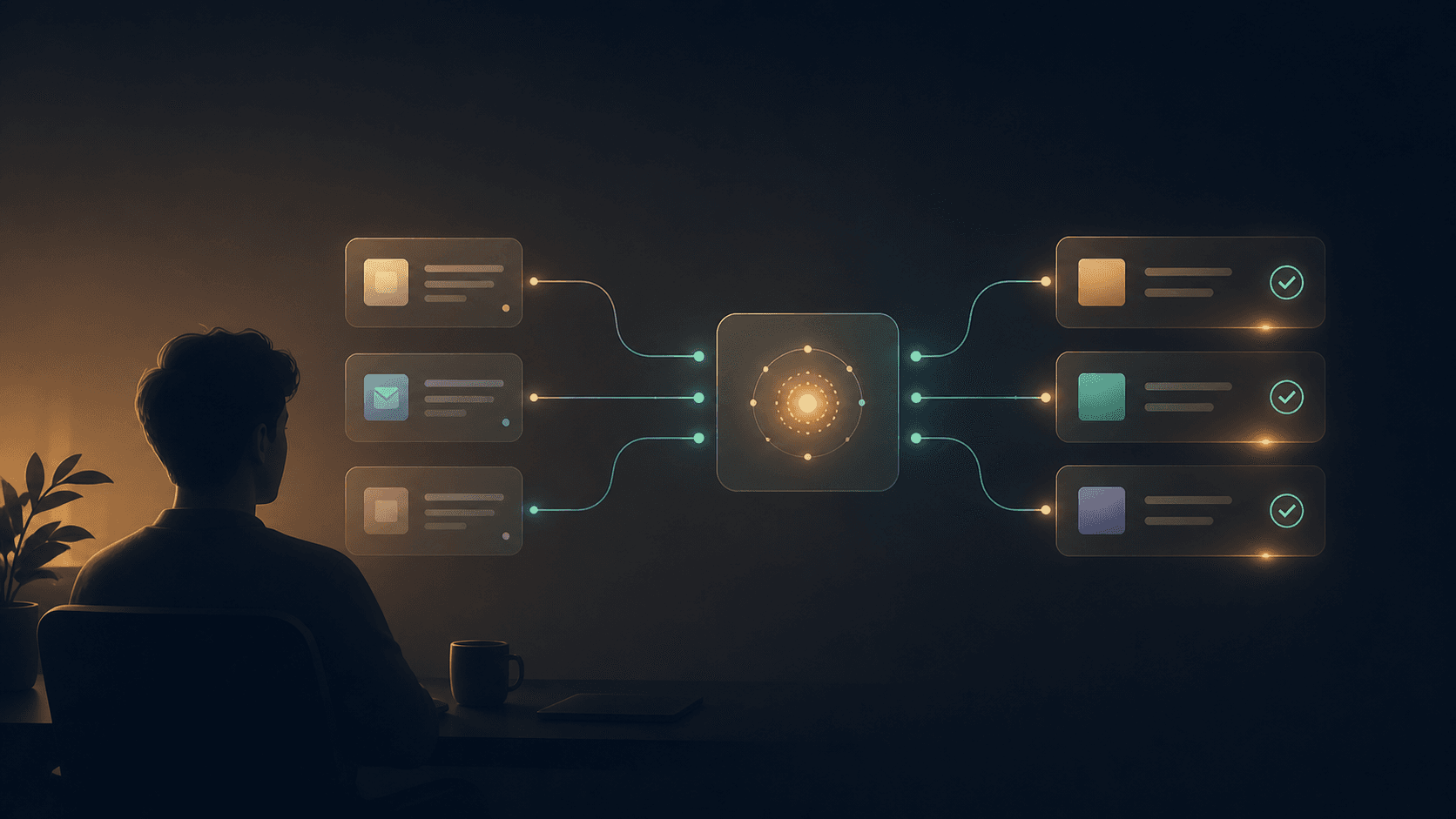
We built this workflow to monitor user behavior patterns within the first 72 hours and trigger personalized guidance paths automatically.
-
Map Critical Activation Events - Identify 3-5 key actions that predict long-term success (project creation, team invites, first report generation)
-
Define Behavioral Triggers - Set specific thresholds: spent 5+ minutes in reporting section, created 2+ projects, invited 0 team members after 48 hours
-
Create Dynamic User Segments - Build behavior-based categories: Advanced Feature Explorer, Setup Struggler, Reporting-Focused User, Team Collaboration Leader
-
Design Contextual Content Paths - Develop specific email sequences, in-app messages, and tutorial recommendations for each behavioral segment
-
Integrate Data Sources - Connect CRM (Salesforce/HubSpot), product analytics (Amplitude/Mixpanel), and communication platforms (Intercom/Customer.io)
-
Configure Automated Triggers - Set workflow rules: if user explores Feature X for 10+ minutes within 24 hours, trigger Advanced Feature X email series
-
Establish CSM Handoff Points - Define escalation rules: if user shows no engagement after 72 hours despite 2 automated interventions, assign to CSM for direct outreach
-
Implement Feedback Loops - Track engagement with automated content and adjust triggers based on what drives actual feature adoption
Tools Used for AI Workflow Customer Onboarding
Core Workflow Engine: Make (formerly Integromat) for complex conditional logic and multi-step automation sequences
CRM Integration: HubSpot for contact management and lead scoring updates
Product Analytics: Amplitude for behavioral event tracking and user journey analysis
In-App Messaging: Appcues for contextual onboarding prompts and feature highlighting
Email Automation: Customer.io for dynamic, behavior-triggered email sequences
AI Content Personalization: Claude API via Make for generating personalized email content based on user behavior patterns
Data Warehouse: Snowflake for centralized customer behavior data (optional but recommended for enterprise implementations)
Visual Logic: How AI Workflows Respond to User Behavior
New User Signup → Amplitude Event Tracking → Behavior Analysis (24-72 hours)
     ↓
User Behavior Classification:
• Heavy Feature X Usage → "Advanced Explorer" Segment
• Stuck on Setup Step Y → "Setup Assistance Needed" Segment
• Dashboard Focus Only → "Executive Overview" Segment
• No Engagement → "Re-engagement Required" Segment
     ↓
Make Workflow Triggers:
Advanced Explorer → Advanced Feature Tutorial + Use Cases
Setup Assistance → Step-by-Step Guide + In-App Prompts
Executive Overview → ROI-Focused Content + Dashboard Training
Re-engagement → Simplified Getting Started + CSM Assignment
     ↓
Personalized Delivery:
Customer.io Email → Appcues In-App Message → HubSpot CRM Update → CSM Notification (if needed)
     ↓
Continuous Monitoring → Behavior Response Tracking → Workflow Refinement
Example Output: Project Management SaaS Implementation
A new enterprise client with 50 users signs up for our project management platform. Within 48 hours, our AI workflow identifies distinct behavioral patterns:
User Profile: Sarah (Operations Director)
- Spent 12 minutes exploring advanced reporting features
- Created 1 project but hasn't invited team members
- Viewed dashboard customization options 3 times
AI Workflow Response:
- Email Triggered: "Advanced Reporting Mastery: Turn Your Data Into Strategic Insights" (personalized with her company name and industry benchmarks)
- In-App Message: Contextual prompt in reporting section: "Create your first custom KPI dashboard in 3 clicks"
- CRM Update: Tagged as "Reporting Power User - High Value Expansion Opportunity"
- Follow-up Scheduled: 7-day automated check-in with ROI calculator specific to reporting features
Measurable Result: Sarah completed advanced dashboard setup within 3 days and became internal champion for platform expansion to additional departments.
Before vs After: Quantified Onboarding Transformation
| Metric | Before AI Workflows | After AI Workflows | Improvement |
|---|---|---|---|
| Time to First Value | 8.5 days average | 4.2 days average | 51% faster |
| Feature Adoption Rate | 35% use 3+ key features | 67% use 3+ key features | 91% increase |
| Support Tickets | 2.3 per user (first 30 days) | 0.9 per user (first 30 days) | 61% reduction |
| CSM Time per Account | 12 hours initial setup | 4.5 hours strategic guidance | 63% efficiency gain |
| 90-Day Retention | 78% | 89% | 14% improvement |
| Expansion Revenue | 23% of accounts | 41% of accounts | 78% increase |
Advanced Workflow Optimization Strategies
Behavioral Scoring Integration - Assign point values to different actions (project creation = 10 points, team invite = 15 points) to trigger increasingly sophisticated guidance paths.
Multi-Touch Attribution - Track which combination of automated touchpoints drives actual feature adoption, not just email opens or clicks.
Predictive Churn Modeling - Use Claude API to analyze behavioral patterns and predict which users need immediate CSM intervention before disengagement occurs.
Cross-Department Mapping - For enterprise accounts, automatically identify different user roles and trigger role-specific onboarding sequences simultaneously.
Tip: Start with 3 clear behavioral segments rather than trying to personalize for every possible user action. Complex workflows often break down - simple, reliable automation beats sophisticated systems that fail.
Measuring AI Workflow ROI for Customer Onboarding
Track these specific metrics to validate your automation investment:
Engagement Velocity: Measure days from signup to first meaningful product action (not just login)
Feature Adoption Depth: Count users engaging with 3+ core features within first 30 days
Support Deflection Rate: Track reduction in basic "how-to" support tickets
CSM Efficiency Ratio: Calculate revenue per CSM hour before and after automation
Expansion Pipeline Quality: Monitor which automated onboarding paths correlate with account growth
Most implementations see 25-40% improvement in these metrics within 90 days. Enterprise SaaS companies typically achieve full ROI within 6 months through reduced churn and increased CSM productivity.
Implementation Roadmap and Common Pitfalls
Phase 1 (Weeks 1-2): Map your current onboarding funnel and identify the 3 most critical user actions that predict success
Phase 2 (Weeks 3-4): Set up basic behavioral tracking in your product analytics tool and create initial user segments
Phase 3 (Weeks 5-6): Build your first AI workflow connecting one behavioral trigger to one personalized action
Phase 4 (Weeks 7-8): Test with small user cohort, measure engagement, and refine triggers based on actual results
Common Mistakes to Avoid:
- Over-personalizing too early - start simple and add complexity gradually
- Ignoring data quality - ensure your product analytics accurately capture user actions
- Forgetting the human handoff - AI workflows should enhance, not replace, strategic CSM relationships
Clear Outcome: What You Can Realistically Achieve
Implementing AI workflows for customer onboarding automation delivers measurable business impact within 90 days. You can expect 30-50% faster time to value, 20-30% higher feature adoption rates, and 40-60% reduction in basic support tickets.
Your CSMs will shift from repetitive onboarding tasks to strategic account growth conversations. Users receive contextual guidance exactly when they need it, leading to deeper product engagement and higher retention rates.
The key is starting with clear behavioral triggers, reliable automation tools, and consistent measurement of what actually drives user success in your specific product.